
Sub-Total: $0.00
Voynich Manuscript- The First Botanist Education Book or Hoax
I am always fascinated by “old” books and love adventuring through thrift store and antique shopping for them. The authors of books written about plants even just one hundred years ago have a lot to teach us.
Our world has changed so much that plants grown in the year 1900 will look different than the same type of plant grown in the year 2022. Between water source, air, sun light and other factors it can affect color, size and general growth.
I wanted to share some articles about an interesting book that is from the 15th century. I love twilight zone and detective mysteries this book has created a whole lot of them. The Navajo Indians of America that save World War II spoke a language known only to them and our enemies could not crack it. Why could it not be possible that at one time 600 years ago there was a language that has died and as far as the plants, well animals have gone extinct why not plants. Either way I will choose to believe someone very passionate about plants wrote this manuscript and will be one of the ones that maintain a dedication to it being real and important. Read for yourself and enjoy.
The book the Voynich manuscript, was found by a book dealer in an old chest outside of Rome in 1912, was carbon-dated by a team of scientists from the University of Arizona, according to an UA press release.
Carbon-14 dating suggests the book was created between 1404 and 1438
The team, led by Greg Hodgins of the University’s department of physics, dated the book back to the early 15th century. The manuscript is written on animal skin (which allowed it to be dated), and now outdates the Gutenberg Bible by 25 years.
For the last century, the Voynich Manuscript, a renaissance codex of 234 pages measuring 22.5 by 16 centimeters and written in an unknown language, has resisted all attempts to fathom its mysteries.

Has a botanist solved the mystery of the
Voynich Manuscript?
by Julia Fleischaker

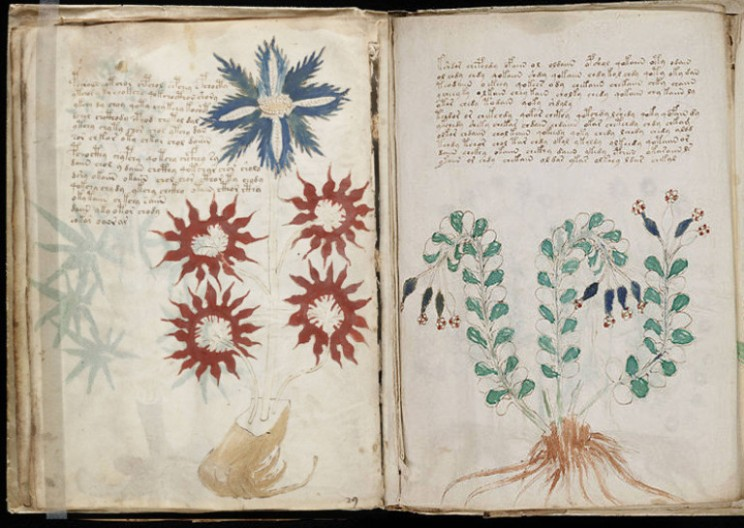
One of many botanical illustrations in the Voynich Manuscript. Could they be the clue to deciphering the mysterious document?
Since it was discovered in 1912, the Voynich Manuscript has confounded scholars and researchers. Named for the collector who discovered it, the manuscript is a seemingly untranslatable text, in an unidentifiable language. The pages, made out of calf-skin or vellum, have been dated to the 15th century, and include illustrations, including an entire section on botany, with illustrations of plants that we’ve also been unable to identify. The manuscript has been dismissed as a hoax, called a prophecy, and almost everything in between. i09 notes that the manuscript is so intriguing “that it’s turned up in fantasy tales from Codex, by Lev Grossman, to Assassin’s Creed.” And it even inspired our very own Rachel Cantor, who made the manuscript a plot point in A Highly Unlikely Scenario.
A botanist from Delaware thinks he may have cracked the mystery. Noticing that many of the herbal illustrations bore similarities to 16th century Mexican plants, Dr. Arthur Tucker of Delaware State University and his research partner started investigating. At HerbalGram, Tucker writes that taking the botanical illustrations as a starting point enabled them to help place the manuscript geographically.

We were both immediately struck by the similarity of xiuhamolli/xiuhhamolli (soap plant) illustrated on folio 9r in the 1552 Codex Cruz-Badianus9-12 of Mexico (sometimes known as the “Aztec Herbal”) to the plant in the illustration on folio 1v of the Voynich Ms. Both depictions have a large, broad, gray-to-whitish basal woody caudices with ridged bark and a portrayal of broken coarse roots that resemble toenails. The plant in the Codex Cruz-Badianus is in both bud and flower with leaves that have a cuneate (wedge-shaped) base, while the plant in the Voynich Ms. has only one bud with leaves that have a cordate (heart-shaped) base. The illustration in the Codex Cruz-Badianus is accepted by numerous commentators9-12 as Ipomoea murucoides Roem. & Schult. (Convolvulaceae); the illustration in the Voynich Ms. is most certainly the closely related species I. arborescens (Humb. & Bonpl. ex Willd.) G. Don. However, the portrayals of both of these Mesoamerican species are so similar that they could have been drawn by the same artist or school of artists.

By identifying and matching the plants to their 16th century Mexican counterparts, and then comparing the names they’d been given in the manuscript to their historical names, it should be possible to crack the code and finally translate the mysterious document. Tucker argues that the language could turn out to be an extinct form of Nahuatl, the language the Aztecs spoke. Has Tucker solved the mystery of the Voynich Manuscript by placing its provenance once and for all in the New World? Lisa Grossman at New Scientist isn’t convinced, and she’s not alone.
Gordon Rugg of Keele University in the UK remains skeptical. He thinks a careful forger could have made up plausible-looking plants. “It’s pretty good odds that you’ll find plants in the world that happen to look like the Voynich manuscript just by chance,” he says. “If I sat down with a random plant generator software and got it to generate 50 completely fictitious plants, I’m pretty sure I could find 20 real plants that happen to look like 20 of the made-up plants.” Tucker admits that there is work to be done before they can throw out the hoax hypothesis entirely. But one of the Voynich plants makes him wonder: it looks strikingly similar to Viola bicolor, the American field pansy, which only grows in North America. The distinction between this plant and its European relative, Viola tricolor, was not known until after the Voynich was discovered. Ruling out time travel, says Tucker, how would this have been possible? “If this is a hoax, they did a dang good job and had help from a competent botanist who had knowledge only available after 1912 in some crucial cases.
#VoynichManuscript
