
Sub-Total: $0.00
Poinsettia, to Trash or Transition after the Holidays?
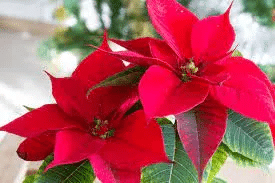
Poinsettia, (Euphorbia pulcherrima), pronunciation- poyn.seh.tee.uh
It is a well-known member of the spurge family (Euphorbiaceae), commonly sold as an ornamental at Christmastime. The poinsettia is native to Mexico and Central America, where it grows in moist, wet, wooded ravines and on rocky hillsides. It was named for Joel R. Poinsett, who popularized the plant and introduced it to floriculture while he was U.S. minister to Mexico in the late 1820s. Cultivated varieties are available with white, pink, mottled, and striped bracts, but the solid red varieties, in several shades, remain in greatest demand during the Christmas season.

The history and back story of the plant has been explained. Let’s be real, how many of you got a small plant as a gift or even bought one yourself to decorate during the holidays? Ok, now for the really hard admittance, did you own the fake silk version?
Most people as the Christmas tree gets tossed in their waste pick up the poinsettia potted plant gets thrown out because it is dead.
Let’s explore the option of keeping it alive for years to come, as well as talk about planting outdoors.

Quick facts
- Poinsettias bloom when the days get shorter.
- Poinsettias grow well in moist soil and temperatures between 65- and 70-degrees F.
- They can be grown outdoors during summer.
- Poinsettias are not poisonous, but the sap may cause dermatitis.
- Poinsettias change color in response to shorter winter days.
- The tiny yellow flowers in the center are called cyathia.
- The colorful bracts attract insects to the flowers and will drop after pollination.
I trust University Extensions and their plant biology teachers. This is a great resource I found. Julie Weisenhorn, Extension educator, horticulture
“How can I make my poinsettia rebloom?” is a common question.
Poinsettias can be grown as attractive green plants, but most people are interested in making their green poinsettia colorful again and ready for the holidays.
It is not an easy task, as it requires excluding light from the plant for a period of time while keeping the plant healthy. The reduction in light prevents the plant from producing chlorophyll, the pigment that makes plant parts green. This changes the bracts to red, pink, or white, depending on the poinsettia variety.
Dr. Leonard Perry, Extension professor emeritus at the University of Vermont and author of Caring for Your Poinsettia Year-Round, developed an easy-to-follow poinsettia care calendar based on the holidays of the year.
New Year’s Day
- Fertilize if you see new growth.
- Continue to provide adequate light and water for a prolonged bloom for several weeks.
Valentine’s Day
- Check your plant for signs of insects, such as whitefly, and manage them if you find them. See Managing insects on indoor plants.
- If your plant has become long and leggy, cut back to about five inches tall to promote more compact growth.
St. Patrick’s Day
- Prune off faded and dried parts of the plant.
- Remove leaves from the soil surface and add a little more potting soil if the roots are visible.
- Continue keeping the plant in a bright, sunny window.
Memorial Day
- Trim off two to three inches of branches to promote side branching.
- If you plan to continue growing your poinsettia as a potted plant, transplant it into a container.
Father’s Day
- Move the plant outside for the summer and place it in indirect light.
- You can also transplant it directly into your garden.
Fourth of July
- Trim the plant again.
- Move it into full sun.
- Continue to water and fertilize but increase the amount to accelerate growth.
Labor Day
- Move indoors to a spot that gets at least six hours of direct light daily, preferably more.
- As new growth begins, reduce the fertilizer to one-quarter the recommended strength.
Fall equinox
- Starting on or near Sept. 21, give the plant 16 hours of uninterrupted darkness (put the plant in a closet, basement, or under a box) and 8 hours of bright light every day. Note that during the dark period, the plant cannot receive even the slightest bit of light at any time.
- Maintain night temperatures in the low 60 degrees F range.
- Continue to water and fertilize at a reduced rate.
- Rotate the plant daily to give all sides even light.
Thanksgiving
- Discontinue the short day/long night treatment.
- Put the plant in a sunny area that gets at least six hours of direct light.
- Reduce water and fertilizer.
Christmas
Enjoy your “new” poinsettia. Start the cycle all over again after the new year.
I hope this inspires you to save your poinsettia this year, good luck
#Poinsettias
