
Sub-Total: $0.00
Mistletoe- Christmas Kissing Magic or Parasite Pain
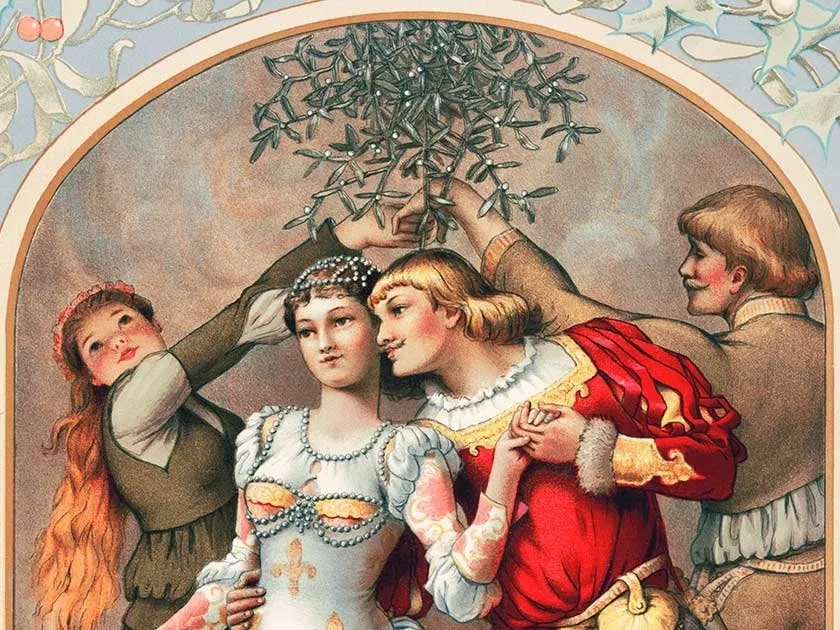
This Blog will feature Mistletoe. I have had the pleasure buying it in little bags with ribbon from kids raising money and I have used a pole saw to pull it from trees on my property. Yes, I have participated in the silly fun tradition of kissing under it. In this Blog my goal is to help you understand the botanical side of it and the path ir has taken in human history to get where it it in our traditions.
The History of Mistletoe
Kissing under sprigs of mistletoe is a well-known holiday tradition, but this little plant’s history as a symbolic herb date back thousands of years. The Greeks were known to use it as a cure for everything from menstrual cramps to spleen disorders, and the Roman naturalist Pliny the Elder noted it could be used as a balm against epilepsy, ulcers and poisons.
The plant’s romantic overtones most likely started with the Celtic Druids of the 1st century A.D. Because mistletoe could blossom even during the frozen winter, the Druids came to view it as a sacred symbol of vivacity, and they administered it to humans and animals alike in the hope of restoring fertility.
Another famous chapter in mistletoe folklore comes from Norse mythology. As the story goes, when the god Odin’s son Baldur was prophesied to die, his mother Frigg, the goddess of love, went to all the animals and plants of the natural world to secure an oath that they would not harm him.
But Frigg neglected to consult with the unassuming mistletoe, so the scheming god Loki made an arrow from the plant and saw that it was used to kill the otherwise invincible Baldur. According to one sunnier version of the myth, the gods were able to resurrect Baldur from the dead. Delighted, Frigg then declared mistletoe a symbol of love and vowed to plant a kiss on all those who passed beneath it.

Taxonomy -The Garden Nerd Details
Common name(s): mistletoe, common mistletoe, European mistletoe, European white-berry mistletoe
The eastern mistletoe native to North America, Phoradendron leucarpum,
Scientific name: Viscum album European Variety
Family: Santalaceae
Origin: native
Flowering season: evergreen
Habitat: canopies of broadleaf trees, orchards
Leaves: oval, evergreen leaves which grow in pairs.
Flowers: its small, white flowers are made up of four tiny petals and form in clusters of three to five. Mistletoe is dioecious meaning male and female flowers are produced on separate plants.
Fruit: a waxy, white berry which grows in clusters of two to six. The seeds inside are coated in a sticky substance which sticks to the beaks of birds feeding on the fruit.
They either wipe the substance off on a branch or eat it and excrete it on trees in their droppings. The gluey pulp around the seed hardens and fastens the seed in place. As the new mistletoe plant grows, the roots penetrate the bark and start to take water and nutrients from the tree.
Look for Mistletoe in the canopy of trees; it is commonly found in apple, lime and poplar but has also been recorded on blackthorn, hawthorn, rowan and willow. Mistletoe can produce some of its own food via photosynthesis but takes minerals and water from the host tree.
The mistletoe’s leaves are green all year round but are more visible in the winter once the other trees have lost their leaves. The white berries appear from around October until May.
All mistletoe species are hemiparasites because they do perform some photosynthesis for some period of their life cycle. However, in some species its contribution is very nearly zero.
There are 1500 species of mistletoe, varying widely in toxicity to humans; the European mistletoe is more toxic than the American mistletoe, though concerns regarding toxicity are more prevalent in the US. The effects are not usually fatal. In parts of South Asia, they are frequently used as an external medicine. Toxins are more concentrated in the leaves and berries of the plant, with teas prepared from the plant being particularly dangerous. While adults may suffer little effect, these are more pronounced in small children and in animals.
Mistletoe has been used historically in medicine for its supposed value in treating arthritis, high blood pressure, epilepsy and infertility.
REMOVAL & CONTROL

Because of its parasitic nature, mistletoe can weaken or destroy the trees it infests, especially if the tree has been compromised by pests, storms, or old age. Removing mistletoe may help revive the tree. There are two common removal methods, neither of which is easy.
Pruning
Mistletoe may be cut out of the tree. Remove the roots by pruning the infested branch at least six inches below the spot where the mistletoe is attached. Unfortunately, pruning can damage the tree’s structure, making the cure worse than the problem.
You can avoid climbing into trees by using a pruning pole. Be sure to take safety precautions when cutting branches out of trees, including wearing head and eye protection. After handling mistletoe plants, wash your hands thoroughly hot, soapy water.
Growth Regulation
A specialized growth regulating chemical can be applied to the mistletoe when the host tree is dormant, usually from December to early February. If applied while the tree is actively growing, this chemical–Ethephon–will damage the tree.
Ethephon must be applied by a licensed pest control operator. Contact your local county Extension office for more information about chemical regulation of mistletoe.
MAKING DECORATIONS
Once you have cut mistletoe out of the trees in your yard, consider making holiday decorations from the pruning. Refrigerating fresh cut sprigs will help keep them fresh until you are ready to prepare them for decorative use.
Use thin florist wire to wrap the ends of short mistletoe cuttings. Add ribbons for color, and your mistletoe is ready to hang over a doorway. Mist the sprig daily to keep it looking fresh. After handling mistletoe plants, wash your hands thoroughly hot, soapy water.
Do not hang mistletoe directly above heaters, stoves, fireplaces, or any other heat-producing elements. Mistletoe hung in these locations will dry out much faster, creating a fire hazard.
#mistletoe
