
Sub-Total: $0.00
Guardians of Nature: Praying Mantis
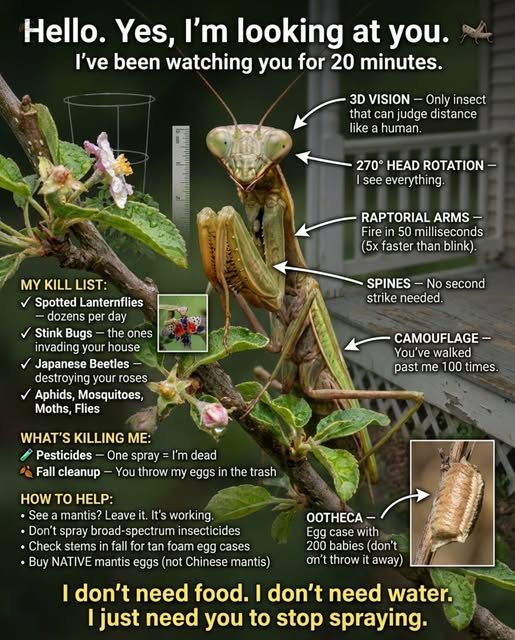
I am a long-time follower of the Guardians of Nature community on Facebook, and they recently shared an insightful article highlighting the vital role of the praying mantis in maintaining ecological balance.
The article explains how this remarkable insect helps control populations of the spotted lanternfly, an invasive pest that poses a serious threat to plants and ecosystems. By acting as a natural predator, the praying mantis contributes to sustainable, chemical-free pest management and supports biodiversity.
I encourage you to take a moment to read and enjoy this informative piece. It’s a great reminder of how even the smallest creatures play an essential role in protecting our environment.
My head rotates 270 degrees. I’m the only insect with 3D vision. I can judge distance the way you do. And I’ve been sitting on your tomato cage watching you for 20 minutes.
I’m a Praying Mantis. And I just ate the spotted lanternfly that was heading for your maple tree.
 The speed
When a pest lands within range, my forelegs fire in about 50 milliseconds. That’s roughly 5 times faster than a human blink. Both arms are lined with spines. One strike is all it takes.
Between strikes, I don’t move. I don’t chase. I sit on a branch or a stem and wait. For hours. Motionless. Invisible.
You’ve walked past me a hundred times without seeing me.
 The menu
Spotted lanternflies get the headlines, but I’m a generalist. I eat whatever shows up within reach.
Brown marmorated stink bugs — the ones invading your house every fall. Japanese beetles working through your roses and grape vines. Aphids on your tomatoes. Mosquitoes, grasshoppers, moths, flies. I don’t specialize. I eliminate whatever lands near me.
 The vision
I’m the only insect with true stereoscopic vision. My two compound eyes work together to calculate distance the same way yours do — by comparing the slightly different image from each eye. This is what makes my strike so accurate. I don’t guess where the prey is. I measure it.
And my head rotates 270 degrees on my neck, which means I can track movement behind me without shifting my body. Nothing nearby moves without me knowing.
 What helps me stay in your garden:
– When you see a mantis — leave it alone. It’s working. It doesn’t need food, water, or shelter from you. It just needs to not be disturbed
– Don’t spray broad-spectrum insecticides. One application kills me just as effectively as it kills the pests I eat. The pest population rebounds in weeks. Mine doesn’t
– In fall, check plant stems and branches for egg cases before cutting anything back. They look like tan foam blobs about the size of a walnut — each one contains around 200 eggs. If those stems go into the yard waste bin, 200 mantises go with them
– If you want more mantises, buy native egg cases — look for Stagmomantis carolina, the Carolina Mantis. Avoid Chinese mantis egg cases, which are more commonly sold but are a non-native species that can outcompete natives
– Leave some tall plant stems standing through winter — these are where egg cases overwinter safely
I don’t need anything from you except for you to stop spraying. I’ve been protecting your garden since before you planted it. You just never saw me.
I hope you gained some new knowledge that will assist your garden. Mantis eggs can be purchased from online locations or nurseries. Do your part to control invasive pests and improve your gardens health
