
Sub-Total: $0.00
Planting Under Oaks Successfully
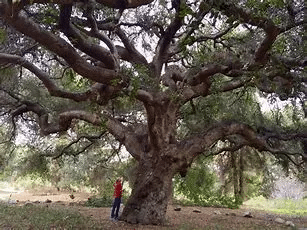
I live on the Central Coast of California, near Paso Robles or El Paso De Robles, which in Spanish means The Pass of The Oaks. So, to honor this area, this Blog is about living with Oaks successfully.
Where oaks grow natively, whether standing alone or in a mixed woodland, the ground beneath is home to very few understory plants. In the home landscape, when gardeners would like to give the area under oaks a fuller look, some research is needed to determine what can be added there without negatively impacting the trees. The question usually is: “What can be planted under or near native oak trees to obtain a bit more of a landscaped look?”
Sadly, there are too many stories like this one: New-comers to Sonoma County purchased a home with a magnificent spreading, 200-year-old oak tree. Not knowing any better, they planted a lawn around it for their children’s play. Some years later, they heard a stupendous crash and looked out to see that this magnificent tree had toppled over. The lawn and its associated water had killed the venerable giant in a matter of a few years.
To avoid such a catastrophic situation, it’s critical to partner oaks only with plants that associate with them in the wild or with others that thrive in dry shade. In short, plant choices for landscaping in and around oaks are limited.
In the Central Coast area where it has Mediterranean, winter-wet, summer-dry climate, only certain species are adapted to conditions that oaks enjoy. When soils are moist in winter, few disease organisms that could threaten oaks are active in the soil. But in summer heat, threatening soil pathogens are active when moisture is present.
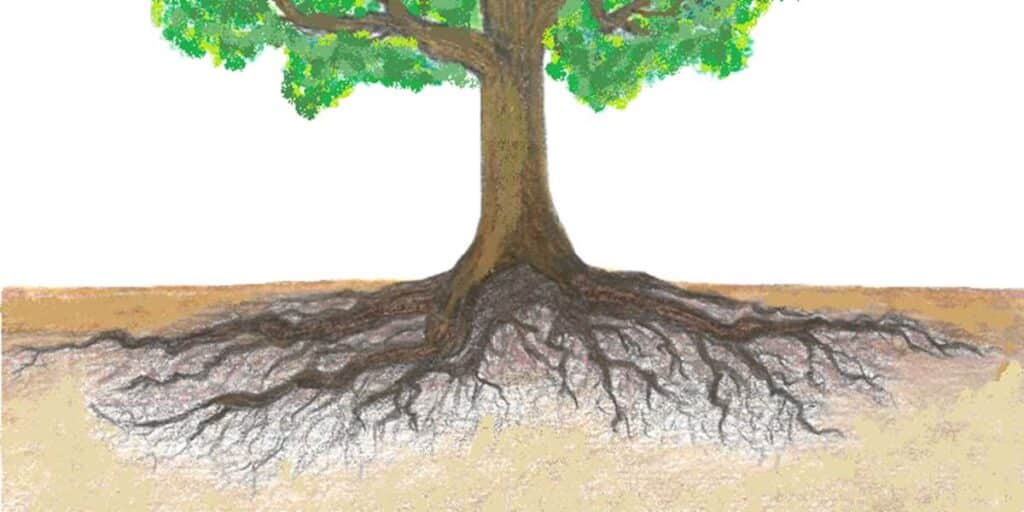
The first part of an oak tree’s root system to develop is the taproot, which will go deep into the earth looking for a water source. Next, the lateral roots begin to form and spread as far as 90 feet from the trees base and are shallow, staying as close as 18 inches from the soil’s surface. This horizontal root system is what will support the tree for the extent of its life. This is why we must be very careful when planting around oak trees so as not to disturb the tree’s shallow roots.
Plant at least 6 ft from the tree’s drip line and only use hand tools, no heavy machinery. If you’re digging and find a root, stop digging there, and find another place to plant. It’s a good idea to plant immature plants that don’t require digging a deep hole.
The Californian Mediterranean climate has long, dry summers, so native plants have needed to adapt in order to survive in this climate. Much of the native vegetation, including oak trees, have sclerphyllous foliage, meaning that their leaves are small, dark, and have a waxy outer layer to retain moisture in the dry summer months. Only during times of extreme drought will an oak tree need to be irrigated and it is best to get the advice of an Arborist if you think your oak does need water.
Watering your oak trees can cause fungi such as Armillaria mellea or Ganoderma lucidum which will produce root rot and can ultimately lead to the tree dying. Signs of root rot include:
–Small, yellowing leaves –Wilting or dying branches –Seeing fungal growth around the base of the tree or on the bark, –Smelling a mushroom like odor.
If your trees exhibit any of these signs, call an Arborist and have them to come and treat your tree’s root rot.

Guidelines for planting under and around oak trees
The best time to introduce new plants is October through March when the soil is cool and moist.
- Find an alternative for digging or trenching that cuts roots when altering your landscape. Since you cannot dig holes to accommodate large plants under your tree, you will need to plant small seedlings or divisions. You may be able to buy small “liner” plants in bulk from some mail-order nurseries. These are seedlings intended to be grown on at nurseries and sold as plants in garden centers. If you can find a source for liners, you’ll save a lot of money. Of course, you could always start your own. The main concern is that you want seedlings with small root balls, so you can squeeze them in without digging too wide or deep. This will mean a lot of water at first, but the small plants will adapt more easily to their cramped quarters than a large plant would, and you won’t hurt your tree in the process of planting.
- Avoid compacting soil under the canopy, changing drainage patterns, or raising or lowering the soil grade, all of which limit oxygen supply to shallow feeder roots.
- If paving is necessary, use porous paving, such as brick or flagstone on sand, or decomposed gravel.
- Choose species that naturally occur with oaks, those with shallow roots that have an affinity for partial or complete shade and no need for summer moisture after becoming established.
- Keep all plants 4-6 feet away from the trunk.
- Keep mulch a foot away from the base of the trunk. The mulch will help retain precious moisture and give the plants a little boost. Reapply the mulch each year in early spring, before the plants have a chance to leaf out. Just be careful not to bury the plants under it.
- Plan for Dry Conditions. It helps if you choose plants that can handle some drought. You will still need to give your plants some TLC for their first year, no matter what you plant. But it will be easier on the plants, and you, if you choose plants that won’t need a lot of supplemental watering during dry spells when the tree’s roots will soak up all available moisture.
- Plant in the fall so winter rains help young plants become established, then need supplemental water for only one season.
- To help get new plants established, water cautiously by hand or with drip irrigation, never sprinklers.
- Use only a few plant varieties but use lots of them. Choose a couple of key plants and then plant them in large swaths. This is especially key since you need to plant very small seedlings.
- Include Some Surprises. To give your underplanting some drama and eye-catching appeal, add a splash of unexpected bold color or unusual texture. It will add another dimension of beauty and make your planting look complete.
- Leaf drop from the trees themselves is best left undisturbed on the ground.

Suggested plants for growing under evergreen or deciduous oaks
Perennials
Classic shade-loving plants in the perennial category include hostas (Hosta spp.), ferns and flowering plants such as Western blue-eyed grass (Sisyrinchium bellum). Ferns like the Christmas fern (Polystichum acrostichoides) are not only drought-tolerant but semi-evergreen in winter. Other flowering perennials that will thrive and spread in the shade include columbine (Aquilegia spp.), creeping phlox (Phlox subulata) and many types of irises, especially Japanese roof iris (Iris tectorum).
Grasses
In deep shade, most turf grasses will fail to thrive, though some types such as St. Augustine’s grass and centipede grass tend to perform better. Ornamental grasses well-suited to partly shady conditions with drier soils include muhly grass (Muhlenbergia spp.) and June grass (Koeleria macrantha). When growing sites have more moisture available, the list grows to include more species, such as northern sea oats (Chasmanthium latifolium), tufted hair grass (Deschampsia spp.) Deer grass (Muhlenbergia rigens) and California fescue (Festuca californica)
Sedges
Seen often in forests, sedges (Carex spp.) are not true grasses, but sport grass-like foliage for a similar effect. Choose sedges adapted to shady or partly shaded sites, such as oak sedge (C. pennsylvanica), plantain-leaf sedge (C. plantangina) or bristleleaf sedge (C. eburnuea). For border areas, choose sun-tolerant varieties like the palm sedge (C. muskingumensis) or bottlebrush sedge (C. hystericina), which form clumps. Though many sedges are drought-tolerant, they will look their best with consistent moisture.
Groundcovers
Avoid the invasive English ivy (Hedera helix), although it’s a traditional groundcover in the shade of trees and buildings, and instead choose a noninvasive alternative. Native Allegheny spurge (Pachysandra procumbens) looks similar to its Asian cousin, but spreads more slowly. Wintergreen (Gaultheria procumbens) is another vining groundcover that maintains some of its shiny green leaves in winter, with the added benefit of minty, edible berries. Ground-creeping sedum (Sedum spurium) spreads quickly and politely in virtually any garden, and many retain its foliage in winter for year-round interest.
