
Sub-Total: $0.00
Heart Shaped Plants for Your Loved One’s Garden
Whether you are seeking a romantic touch for your home or your yard, there are many plants with heart-shaped leaves to choose from.
Plants with leaves that resemble hearts (sometimes called a “cordate” shape) can range from vines to trees, from ground covers to houseplants, and from tropical plants to cold-hardy specimens.
Some have attractive flowers, others stunning leaf color or variegation, while still others light up the landscape in fall with their foliage.
Here are a few plants with heart-shaped leaves to give your home and yard some love.

Heart-Shaped Hoya
There are many types of hoyas, and they differ in color, shape, and size. If you’re looking to give your home some love, Hoya kerrii is one of the best choices. This vine-like succulent has thick, heart-shaped leaves making it perfect for a Valentine’s Day display.
Name: Heart-shaped Hoya (Hoya Kerrii)
Light: Full sun
Mature Size: 13 feet long, width varies

String of Hearts Plant
String of hearts is a popular houseplant, often grown in hanging baskets so that its vines have room to hang down. The marbled foliage is heart-shaped and fleshy. Its thin, string-like vines bear a purplish tinge.
Name: String of hearts plant (Ceropegia woodii)
Light: Partial sun
Mature Size: 1 to 2 inches tall, 1.5 inches wide

Heart-Leaf Philodendron
Many beginners know and love philodendrons, and their heart-shaped leaves are glossy and dark green. New leaves often bear a bronze tinge and measure about 4 inches long; mature leaves can reach a foot long. If provided with a supporting pole, the twining stems will wrap around it.
Name: Heart-leaf Philodendron (Philodendron hederaceum)
Light: Partial sun
Mature Size: 3 to 13 feet long, 1 to 3 feet wide
Warning Philodendron is toxic to humans and to pets.

Anthurium
Anthurium is prized for being a long-blooming houseplant in northern regions. The flowers have waxy spathes (commonly red), from which yellow or red spikes protrude. It’s a great example of a plant with both heart-shaped leaves and heart-shaped flowers.
Name: Anthurium (Anthurium clarinervium)
Light: Indirect, partial sun
Mature Size: 12 to 18 inches tall, 9 to 12 inches wide
Warning Anthurium is toxic to humans and pets.

Cyclamen
Cyclamen persicum is usually grown as a houseplant. If you wish to grow a Cyclamen outdoors, try Cyclamen hederifolium. Cyclamen persicum is a popular Christmas gift for plant lovers. Many treat them as annuals and throw them away when they stop flowering. Alternatively, cut the dead flower stalks off at the base as you find them and remove any yellow leaves. Once the plant begins producing fewer flowers, gradually allow its soil to dry out for two to three months. This will be its dormant period. During dormancy, just barely water it: Excessive water causes the uber to rot.
Name: Cyclamen (Cyclamen persicum)
Light: Indirect but bright light (houseplant)
Mature Size: 6 to 9 inches tall, 6 to 9 inches wide

Foxglove Tree
Also known as the “empress tree, ” or “princess tree,” the foxglove tree is best known for its fragrant, lovely flowers that come in a rather unusual color for a Northern tree: lavender to purple. But you will also enjoy its leaves—not only are they heart-shaped, but they are also enormous: up to 30 inches across. Adding to the list of its pros is the fact that it is a fast-growing tree. But one con that is enough to keep many people from growing is it tends to spread out of control. The foxglove tree is considered an invasive plant in North America
Name: Foxglove tree (Paulownia tomentosa)
USDA Hardiness Zones: 5 to 8
Flower Color: Lavender to purple
Light: Full sun
Mature Size: 30 to 40 feet tall, 30 to 40 feet wide

Dutchman’s Pipe
This perennial vine is commonly seen twining around the columns of people’s front porches. Although named for its flower, its foliage has much more to offer: It is heart-shaped and dense.
Name: Dutchman’s pipe (Aristolochia macrophylla)
USDA Hardiness Zones: 4 to 8
Flower Color: White
Light: Full sun to partial sun
Mature Size: 15 to 30 feet long, 15 to 20 feet wide

Variegated Butterbur
Variegated butterbur is sure to capture attention with its huge, two-toned, heart-shaped leaves. The species plant, common butterbur, spreads vigorously by rhizomes and has been used as a ground cover where large areas need to be filled in. The variegated cultivar does not spread as readily as the invasive species plant. If you want to be extra cautious, grow it in a container.
Name: Variegated butterbur (Petasites japonicus ‘Variegata’)
USDA Hardiness Zones: 5 to 9
Flower Color: Yellowish
Light: Partial shade to full shade
Mature Size: 2 to 3 feet tall, 2 to 5 feet wide

Caladium
Caladium foliage never disappoints. It can be mottled, veined, or striped, but it’s always colorful. This tropical plant grows from a tuber.
Name: Caladium (Caladium spp.)
USDA Hardiness Zones: 9 to 11
Flower Color: Greenish, red, pink, white
Light: Indirect light (indoors), full sun to partial shade (outdoors)
Mature Size: 12 to 30 inches tall, 12 to 24 inches feet wide

Jack Frost Siberian Bugloss
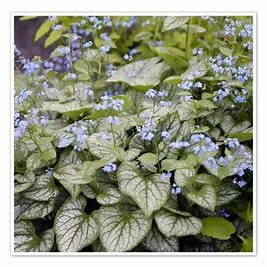
For a plant with heart-shaped leaves that have a silvery coloration, grow the ‘Jack Frost’ cultivar of Siberian bugloss. Plant it in shade to keep the leaf color from fading. This perennial sports attractive blue flowers as well. It spreads by rhizomes but is a slow grower. If you are patient, it will eventually fill in a shaded area to function as a ground cover.
Name: Jack Frost Siberian Bugloss (Brunnera macrophylla ‘Jack Frost’)
USDA Hardiness Zones: 3 to 8
Flower Color: Blue
Light: Full shade to partial shade
Mature Size: 12 to 18 inches tall, 18 to 30 inches wide

Bicolor Barrenroot
Bicolor barrenwort does bloom, but it’s valued more for its variegated leaves. It makes a good foliage plant for shade gardens. The leaves of this clump-forming perennial change color from season to season. The first spring leaves are reddish before turning green in summer. In fall, they assume a reddish color again.
Name: Bicolor barrenwort (Epimedium x versicolor var. sulphureum)
USDA Hardiness Zones: 5 to 9
Flower Color: Yellow
Light: Partial shade to full shade
Mature Size: 1 foot x 1 foot

Morning Glory
Morning glory is an annual vine that comes in various colors. Most people grow it from seed as the plant reseeds readily, making your growing experience much easier. If you sow the seed too late in the spring, it may take quite a while to blossom unless you live where it’s very warm and have ideal conditions for it.
Name: Morning glory (Ipomoea spp.)
USDA Hardiness Zones: 2 to 11
Flower Color: Blue, pink, purple, white
Light: Full sun
Mature Size: 6 to 10 feet tall, 3 to 6 feet wide
Warning Morning glory is toxic to humans and to pets.

Common Lilacs
There are several different kinds of lilacs commonly available at garden centers now. It’s hard to beat the beautiful fragrance of common lilac, though. They boast beautiful heart-shaped leaves and purple flowers.
Name: Common lilac (Syringa vulgaris)
USDA Hardiness Zones: 3 to 7
Flower Color: Purple, white
Light: Full sun
Mature Size: 8 to 15 feet tall, 6 to 12 feet wide

Katsura Tree
Katsura is a tree with a moderate to fast growth rate and a moderate size suited for typical urban or and suburban yards. If you have a smaller yard, grow the dwarf-sized variety that matures at 15 feet in height. Katsura’s fall color is yellow to purplish. Its heart-shaped leaves line up opposite one another along the branches.
Name: Katsura tree (Cercidiphyllum japonicum)
USDA Hardiness Zones: 4 to x8
Flower Color: Reddish, greenish
Light: Full sun to partial sun
Mature Size: 40 to 60 feet tall, 25 to 60 feet wide
Do you have any of these heart shaped beauties? Do you have one not listed?
