
Sub-Total: $0.00
Holiday Cactus Identification Dilemma
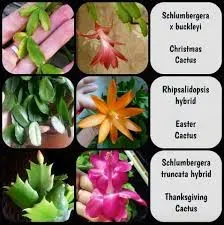
A large craze right now is having one of the 3 types of Holiday Cactus inside your home. The social media boards almost always have a newbie reaching out inquiring which variety they were gifted and how to take care of it.
Regardless of which type they are the flowers are lovely and the dark green of the leaves complement any home. You can get a small one for a reasonable price at any plant nursery or big box store during holiday time.
All three Cacti are epiphytes that grow naturally in Brazil. Thanksgiving and Christmas from rain forests and Easter from drier forests. An epiphyte is a plant that grows on another plant but is not a parasite. They depend on the host tree/plant for support but not food. A list of such plants is some ferns, bromeliads, air plants, and orchids.
Identification of the Holiday Cactus

Both the Christmas and Thanksgiving cactus are listed under the genus Schlumbergera. Previously both plants were named Zygocactus, but in the 1950s plant society chose the genus Schlumbergera instead. A true Christmas Cactus – Schlumbergera bridgesii is rarely available commercially. You can get it from cuttings from someone who already owns one.

Christmas Cactus are usually white or red and occasionally yellow. Bloom time is typically December. They begin growing upright but as it matures the stems are pendent arching down. The Christmas variety has purplish-brown anthers (part of the stamen of the flower that produces pollen). The flowers are symmetrical and extend down. The Christmas Cactus has wide flat segmented leaves that are smaller and rounder than the other two varieties. The edges are slightly notched, and the end or tip of each segment is very slightly curved but can almost look flat.

Thanksgiving Cactus are typically pink, white, red, and sometimes yellow. The blooming time is typically in November. The Thanksgiving Variety has yellow anthers. Flowers are more asymmetrical and protrude from the ovary and extend horizontally from the tips of the stem segments. The Thanksgiving Cactus has broad segmented leaves with jagged edges on each side. There are 2-4 points on each side. The end of the last segment is slightly concave with a point on each side.

The Easter cactus is actually listed under the genus Hatiora. It appears that there are now many hybrids out on the market which is where leaf patterns of flower color come into play to confuse people.

Easter Cactus are lavender, red, orange, white, or pink and are brighter than the other two varieties. The flowers are more star-shaped than the others as well. Typical bloom time is April and May. Easter Cactus has leaves that are similar in some ways to Christmas Cactus. There is a slight scallop on the edges, but it is very subtle. The indentations are more teardrop in shape. The tips of an Easter Cactus have small bristles on the tips.
How to propagate stems: water & dirt methods
Water-
1. Carefully separate a Y-shaped section of leaves with stem at least 4 sections.
2. Grab a jar and place pebbles in bottom about 2 inches.
3. Pour water in jar until it just covers pebbles.
4. Place stem into jar and monitor it inside the house ensuring indirect light and keep pebbles covered with water.
Dirt-
1. Separate a Y shaped section of leaves with stem at least 4 sections. Avoid flowers.
2. In a pot place good succulent potting mix.
3. Press stems in slowly to cover first leaf and keep soil lightly damp in a warm location with good indirect light.
Time to see roots and new growth is about 6 to 8 weeks.
Fertilizer
Fertilize your Holiday Cactus every 2 to 3 weeks. Use half recommended rate for house plants.
The Holiday cactus does not like wet feet but enjoy humidity. Try putting a clay tray filled with pebbles and water under your pot to keep plant moist without wet soil. Water plant itself only when dry.
In summer Christmas Cactus can go outside but in shade. Bring in it in about October and put in cool darker place so it can prepare to flower.
Easter Cactus enjoy being pot bound, however need new soil every two years in spring. So, remove it from pot provide new soil and put it back in same pot. Water it sparingly from Oct to November while having 12 to 14 hours of darkness with cool temperatures of 50 to 60* In December move the plant somewhere warmer and it will flower in February to March.
A wilted or limp Holiday Cactus is sometimes caused by lack of water or too much direct light.
#Zygocatcus #holidaycactus #christmascactus #thanksgivingcactus #eastercactus
