
Sub-Total: $0.00
Cactus Landscaping Features: Saguaro Cactus- Part 1
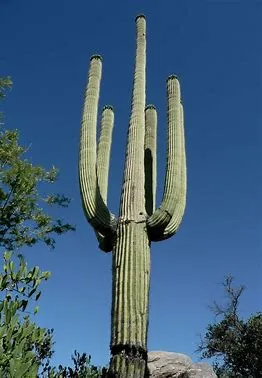
Columnar saguaro plants, also called sahuaro, giant cactus, and sage of the desert, are usually found in Sonora, Mexico, the central/southern Arizona desert, and parts of California. Tall and branching, it is one of the most iconic cacti in the world. Unfortunately, saguaro is one of the least cold-tolerant cacti. Carnegiea is named after American industrialist and philanthropist Andrew Carnegie.
Identifying Features
These plants are large, tree-like columnar cacti that develop branches (or arms) as they age, although some never grow arms. These arms generally bend upward and can number over 25. Saguaros are covered with protective spines, white flowers in the late spring, and red fruit in summer.
Habitat
Saguaros are found exclusively in the Sonoran Desert. The most important factors for growth are water and temperature. If the elevation is too high, the cold weather and frost can kill the saguaro. Although the Sonoran Desert experiences both winter and summer rains, it is thought that the Saguaro obtains most of its moisture during the summer rainy season.
Life Span
With the right growing conditions, it is estimated that saguaros can live to be as much as 150-200 years old.
Size
Saguaro are very slow growing cactus. A 10-year-old plant might only be 1.5 inches tall. Saguaro can grow to be between 40-60 feet tall (12-18m). When rain is plentiful, and the saguaro is fully hydrated it can weigh between 3200-4800 pounds.
Fruit

Ripening in the hottest, driest time of the year, saguaro fruit provide important moisture and nutrition to animals and insects in the Sonoran Desert before the summer monsoon rains.
With each saguaro able to produce an average of 150 fruit, for a few months of the year this cactus is a veritable grocery store in the desert. High atop the saguaro’s branches, the succulent fruit splits into three or four sections in late May to late June, exposing the dark red pulp and a cluster of up to 3,500 seeds.
Birds and bats eat the pulp and seeds of the fruit on the cactus, while on the desert floor coyotes and other mammals feast on the fallen fruit. People indigenous to the Sonoran Desert such as the River Pima, Tohono O’odham, and Southeastern Yavapai depended on the saguaro as a food source in the hot, dry period preceding monsoon rains.

Saguaro fruit tastes very sweet and the seeds, which are high in protein and fats, have a nutlike flavor. The fruit can be eaten both raw and cooked, processed into syrup and jam, and the pulp dried into cakes. The seeds are eaten raw or dried and ground into flour. Juice is made into both alcoholic and nonalcoholic drinks.
Quick Facts

- The saguaro is the largest cactus in the United States.
- Most of the saguaro’s roots are only 4-6 inches deep and radiate out as far from the plant as it is tall. There is one deep root or tap root that extends down into the ground more than 2 feet.
- After the saguaro dies its woody ribs can be used to build roofs, fences, and parts of furniture. The holes that birds nested in or “saguaro boots” can be found among the dead saguaros. Native Americans used these as water containers long before the canteen was available.
If planted near desert trees like mesquite and palo verde, saguaros will be protected from heat and frost. In a landscape, they are attractive when grouped with golden barrels, prickly pears, and drought-tolerant shrubs, such as chuparosa and Baja fairy duster.
- USDA Growing Zones: 8a to 11b
- Color Varieties: Creamy white
- Sun Exposure: Bright direct sun
- Soil Needs: Well-drained grit
The Planting Process
Saguaro’s may be planted at any time of year, if done in warm dry weather. Spring is ideal. Saguaro should be planted into dry soil and preferably not before a rain. The step-by-step process of planting or transplanting small and moderate size saguaro follows most of the same technique used for barrel cacti. The receiving hole in which the saguaro is planted should be prepared to accommodate the tap root in its original shape. Four of the most important considerations when planting saguaro are:
1) plant the saguaro in the same compass direction in which it was previously growing, 2) plant no deeper than the depth it previously grew, 3) refill the planting hole firmly and without any organic amendments, 4) do not water the saguaro after planting for several weeks
Saguaro Orientation
Each side of a saguaro endures a different intensity of sunlight. The west side catches the hot afternoon sunshine as the sun sets. The south side intercepts sun all day in the winter when the sun travels lower across the sky. The east side catches the early morning sun, which can be important for warming the plant on cold mornings. The north side is mostly shaded by the plant itself. The saguaro’s skin will develop differently and will be thicker on the side receiving the most sun. For this reason, a saguaro must not be rotated to a different orientation when transplanted. One side of the saguaro should be marked before moving it from its established location. This may be done using a dab of white paint or by tying a cord around the plant with the knot facing a particular compass direction (most tie materials catch among the spines and are not likely to shift in position. Nurseries often mark the south facing side, while saguaro movers often mark the north side.
Saguaro Planting Depth
Arborists inspecting woody trees will look for trunk flare, a widening of the trunk at the point it meets the soil. Widening of the trunk just above the soil surface is a sign of good trunk flare that bodes well for health of a tree. Saguaro exhibits no trunk flare, or a narrowing (inverse) trunk flare. Young saguaro stems pinch to a narrowed diameter just above the soil surface, as is typical of a barrel cactus. In older saguaro this narrowing trunk flare is usually not evident. The older saguaro stem has widened through secondary growth of wood inside the trunk. The expansion ruptures the skin of the once-narrow base, which becomes bark-like as it expands. The trunk base of an older saguaro can resemble a gray-skinned elephant’s foot. Roots spread out horizontally just below the point where the stem meets the soil.
